
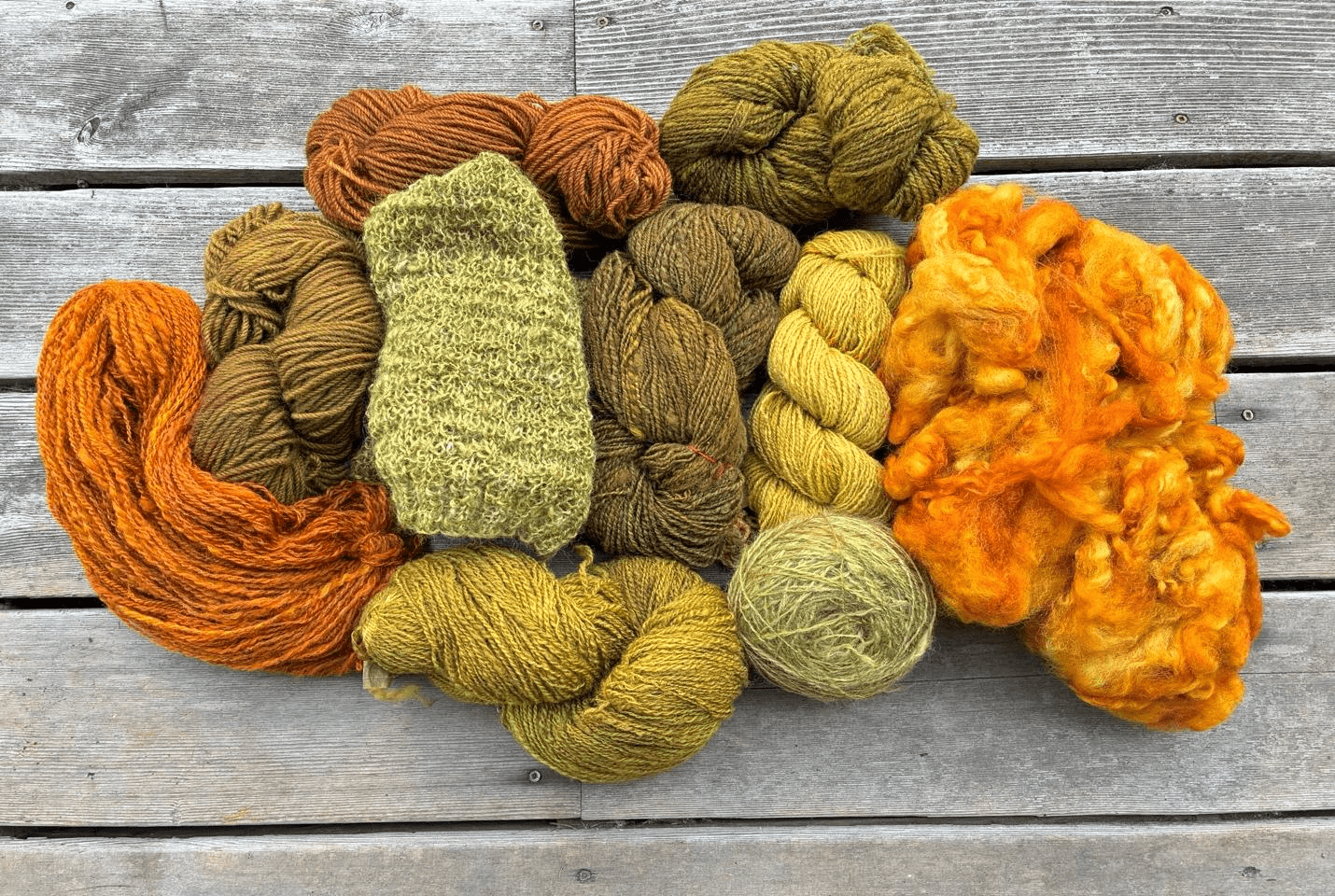
Courtenay-based fibre artist and mushroom forager Amy Crook generously shares her knowledge of dyeing with materials we can find in our Fibreshed region. In this article, she explores Phaeolus schweinitzii, aka Dyer’s Polypore, and the beautiful colours they can provide.
by Amy Crook
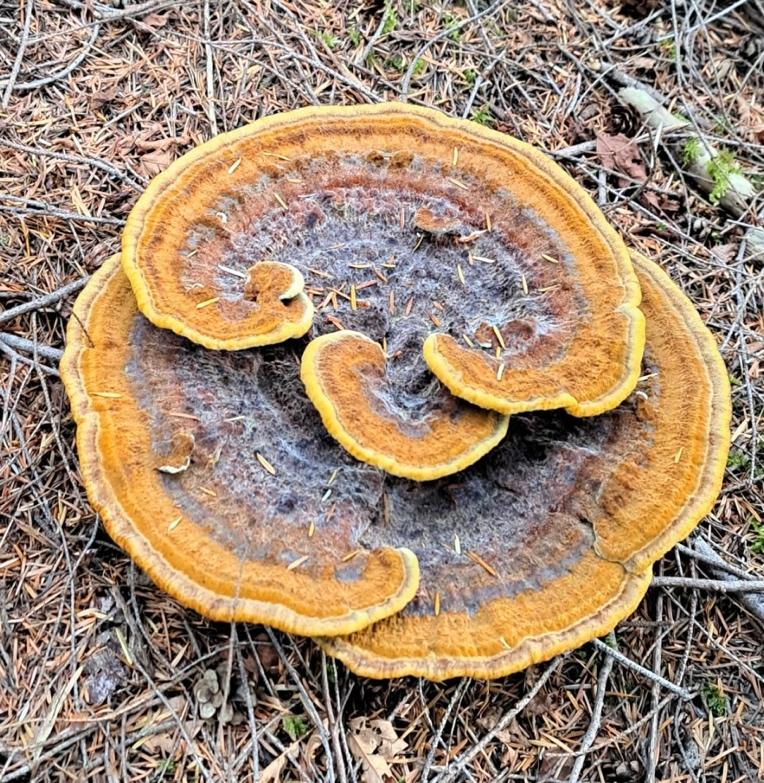
Phaeolus schweinitzii is a reliable and powerful dye source, producing a range of stable yellows, golds, greens, and oranges with different mordants: alum, iron and titanium oxalate. It is a great choice for beginners, giving successful results with less than perfect technique.
Pigment is most rich in this season’s mushrooms. Ideally, collect Phaeolus schweinitzii mushrooms when their outer growing edge is bright yellow and the pores underneath are still yellow-green. Later in the year, more mature Phaeolus schweinitzii will lose the golden edge, but are still good for dyeing, giving rich golds and browns. Old brown mushrooms from last season can give a dull brown color in high ratio of mushroom to fibre (5:1 or more).
Mordanting Fiber:
For animal fibres such as wool, alpaca or silk, mordant the fibres using a metal salt (alum, iron or
titanium) to help the dye bond to the fibre. These three mordants give dramatically different colour
results.
- Mordant the fibre with alum at 7-10% weight of fibre (WOF, dry weight of the fibre) to give bright yellows to deep golds, depending on the age of mushroom.
- Mordant with iron at about 5% WOF to get olive greens. You can add the iron with the alum mordant or make up a separate pot for the iron solution that you will dip the fibre into after it comes out of the initial dye pot, changing the yellow/gold to rich green.
- Mordant the fibre with 8-10% WOF titanium oxalate (potassium titanium oxalate) to give oranges.
Dye Extraction:
Chop mushrooms into small 1” pieces and put into a pot with water. Heat it to a simmer and cook
for about an hour to extract the dye. Phaeolus schweinitzii is forgiving, it can take a bit of boiling
without affecting the dye colors. Leave the mushrooms in the dye pot overnight if you have time
to extract the maximum about of dye. Often mushrooms can be boiled more than once to extract
more dye.
Dye Bath:
A ratio of about 1:1 (dried mushroom to WOF) is a good starting point. Add the mordanted fibre
to the dye bath and simmer for about an hour. If you can, leave the fibre in the dye bath overnight
to extract maximum colour. Rinse fibre well when it’s out of the dye bath. You can often get
multiple dye baths from one collection of mushrooms. The dye bath exhausts give lighter
versions of the original colours which pair well together. Differing the ratios of mushroom to fibre
provides many colour nuances.
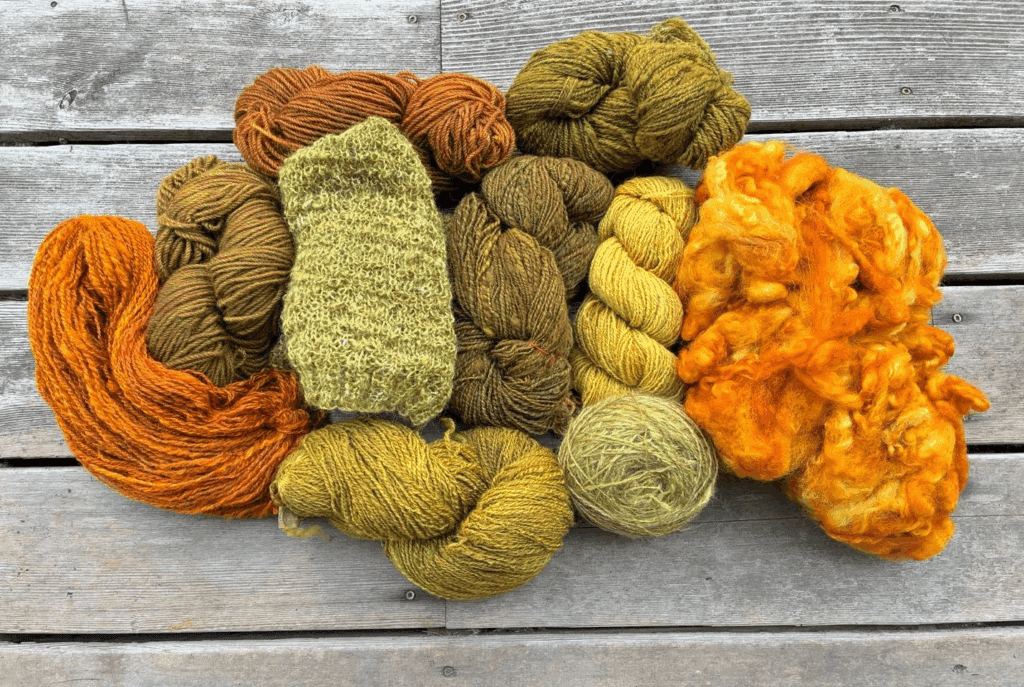
Fibre Colours:
- Yellow/gold- just alum, different aged mushrooms
- Yellow/green- alum mordant then dip into iron pot, very low concentration (2%)
- Olive green- alum mordant then dip into (5%) iron pot. Note: yarn is more green than shown in the photo.
- Orange- mordant in titanium oxalate, simmer in dye bath, leave overnight.